The Internet was invented in 1968 and, in the very beginning, was used mainly for email. In 1991, Tim Berners-Lee invented the World Wide Web as a means to disseminate information to a large number of people. As a matter of fact, he invented HTML, the Web Browser as well as the Web Server.
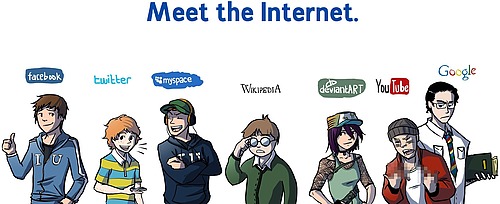
For many years, the Web was mostly one-way traffic until the introduction of Web 2.0 in 2005. Since then, we have seen the emergence of blogging, forums, wikis and, most importantly, social networks. Major social networks include Facebook, LinkedIn, Twitter, YouTube and Google+. Recently, new social networks have gained in importance, among them Instagram, Pinterest and Snapchat.
The move towards Digital Marketing
More and more people are spending a substantial amount of their time online, mainly on social networks. As such, in order to reach out to them for promoting products and services, it is essential for organisations to have a well-defined strategy to use these new digital tools.
In the beginning, organisations resorted mainly to what they knew well: mass advertising, mass emailing and one-way communication. This is what is known as Outbound Marketing and, even though, it can work, it is now generally accepted that there are better ways to reach out to potential customers.
Inbound Marketing is about maximising engagement and establishing authoritativeness. This is done by listening and creating compelling content which addresses the needs of people and sharing these content where people really spend their time. Statistics show that Inbound Marketing is much more effective than Outbound Marketing techniques.
Inbound Marketing is an interactive two-way conversation. Examples are regular posts on a website, podcasts, videos, white papers, case studies, etc. all shared through social media. The best way to convince a customer is to help him/her first.
Work to do
Check the following online resources and comment on them:
 Marketing is mainly about communicating the value of your business to customers. Let’s say you own a beer company which produces a really great tasting beer called Purebrew and you know that most of your customers live in a town called Betatown. In order to communicate the value of your beer and to eventually attract more customers, as a good marketer, you have to market your beer in Betatown. As a conventional marketer, you would probably do this by advertising in Betatown newspapers or by going there and distributing flyers to the Betatown inhabitants. Although that might sound like a great plan it does have some flaws. Most of the inhabitants of Betatown read the newspapers but many of the readers don’t drink beer. Also, many of the people who get the flyers will simply throw them away because either they don’t drink beer or if they do, they are too busy on their way to work to think about which beer to buy. What a waste of money. A waste which you can’t afford since Purebrew has started recently and you are not making a lot of profit right now.
 People shop and learn in a whole new way compared to just a few years ago. Nowadays, customers use social networks like Facebook or Linkedin to participate, collaborate and share views before making purchase decisions. The world of new marketing is about building relationships and trust. The lack of interactivity in conventional marketing methods doesn’t allow that. Through your website and social media networks, you can stay in touch with your customers 24 hours a day and 7 days a week. You can see what customers are talking about and use that information to tweak your products to better satisfy your customers. You can help your customers and answer their queries anytime and believe me, customers love that.
 Digital Marketing allows you to reach out to a greater number of customers at a lower cost. First of all, advertising over social networks for instance is much more affordable than advertising in newspapers. For companies which have a low marketing budget such as start ups, this can be an ideal solution. Second, online marketing is targeted. Advertise to people which have a greater chance of buying your products or services. This will improve your return on investment. Advertise beer only to people who drink beer. “Oh! But how can I know that?” Through social media networks this is possible!
 If you spend Rs 5,000 on marketing and in return get Rs 3,000 of sales, it’s definitely not worth it. But how can you measure that? Well, although it can be possible to measure the impact of conventional marketing methods, most of the time you get the information only after the marketing campaign and can’t really do anything about it. Digital Marketing techniques on the other side has a lot of tools which allow you to track customer acquisition, behaviour and conversion. Those information are available during the campaign and can be used to tweak your marketing strategy immediately. For instance if you notice that a particular post on Facebook has much more interaction than another one, you can take the resources spent on the second less performing post and place them on the first one for even more impact!
 Digital marketing allows you to think bigger. Conventional marketing methods are constrained in the sense that you have to target local customers. Targeting global customers would involve a much greater cost. Online marketing techniques on the other side allows you to target globally at an affordable cost. It allows you to think global.
 WordPress is Search Engine Optimised (SEO)